Judging the AI DMA Awards
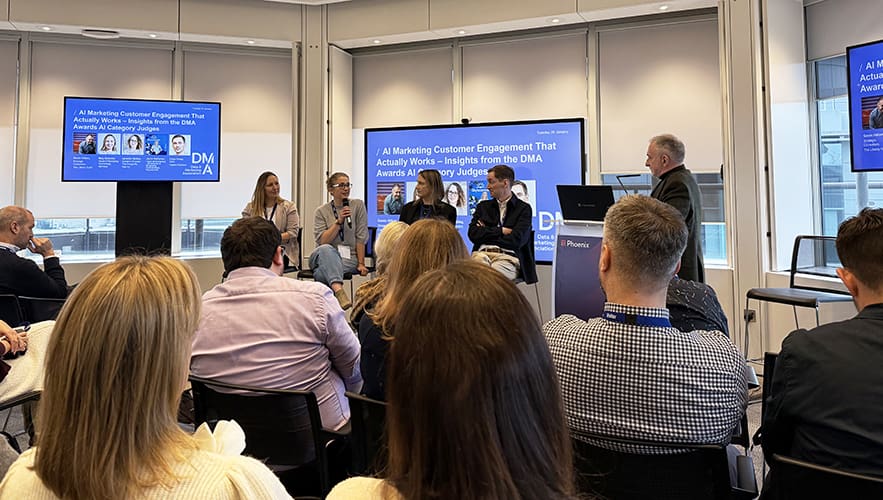
Jen with the mic at the DMA Scotland Event: How AI is driving Customer Engagement through Data, Creativity & Technology in Marketing
Last year I was locked in a hotel room with twelve strangers to speed read, drink coffee, and debate; I highly recommend it. This, of course, was a round of DMA judging, in the AI category to be exact. It was an intense few hours where the ensembled cast of agency characters, esteemed industry experts, and experienced clients all read the entries and discussed if they had enough of the qualifying elements to even be shortlisted.
*See footnote on top tips for making an engaging entry.
Fill out the application form for judging here.
I have been selected for the past two years but unfortunately, I’ve been unable to attend both sessions due to ridiculous circumstances, ‘How not to set your house on fire’ – will be a topic for another blog post. So, I was delighted to be able to attend this year and in the new-ish AI category. It was initially daunting as I am still very much in a learning phase with AI, however, aren’t we all? Even the experts I sat amongst agreed it’s moving so fast, you simply just need to get on the train and get on with it. So, it was all aboard as we dived into reading the entries with headphones on and in total silence – you aren’t even allowed to write notes. It felt very serious, apart from the occasional LOL moments. We ranked the entries anonymously, debated a select few, and the winners were revealed to us during the award ceremony.
This month, I was invited to join a panel with my fellow judges at a DMA event in Edinburgh to discuss the winning entry. Alongside heads of marketing, AI experts, and enthusiasts we discuss why Merkle’s Meerkat entry got GOLD and what that could mean for the future of ideas and AI.
With limited time to express my views on the panel, below is my more in-depth take on the winner and why I feel creatives should be excited by AI (with a few gardening metaphors along the way).
Review the work here.

AI efficiencies doth not an award entry make
What quickly became clear in the entries was AI being touted as a creative time saver and therefore, making it an AI category entry. Being able to make loads of content quickly with AI is a great advantage. But it’s what you can then do with that time and budget saved that is surely more interesting and how you maximise that time. Content based solutions did not make the shortlist.
What was exciting to see was how agencies made really big ideas happen that before just were not feasible – bespoke songs for millions of customers, personalised imagery in millions of versions. The stuff of junior creative portfolio dreams. I was taught to think big, and you can work out how to make it a reality later. This new way of working feels actually feasible in the real world, not just in Art School.
Making AI feel simples
The Meerkat entry came out on top, ticking all the strategic and results boxes easily. The creative part was not so immediately clear because, well, it was so simples. The use of the well-loved Meerkat brand felt like an obvious choice for launching the new AI based product, however it must have been hard to dive back into a concept that has been running for over two decades and find a brand-new angle. What I found interesting was their use of slightly outdated ideas of robots – white plastic bodies and laser eyes – with the final asset resulting in a hybrid of ‘Tomorrow’s World’ and the Terminator with a fluffy head. And there lies the genius. The creative madness that made the idea approachable and understandable for the audience. That for me is the key creative learning from this piece.
Is AI just another pitch competitor?
If you are bringing a customer facing AI solution to market, how you present this is key. That idea, that overarching concept, has never been needed more so than now. We need to be bigger, bolder, and more unexpected.
As with website design – the more professional the finished design looks, the more trust can be built with your customer. With AI being able to generate professional designs in seconds, why not just get it to make a creative wrapper for your AI products? Asking AI directly will get you a solution, but you can also gaffer tape a leaky pipe. AI could and can create unexpected and entertaining creative results. But when you want the job done properly it’s still the place of the professionals.
Could AI have understood the nuances of British sci-fi culture and blend them with the brand to create ‘AutoSergi’? Possibly. But there has always been other creatives to pitch against – we pitch week in, week out. So, if you are worried AI is going to have better ideas than you, then have better ideas. AI can maybe do them faster, but we are all drilled with the ways of the GOOD FAST CHEAP analogue.
(For the uninitiated you can only ever have two of these criteria when working up an idea).
Do you have to be human to be human?
The really fun bit that should excite the creative departments, I feel, is that you now have full blown permission to be madder and more unexpected than ever before and you must be. You can draw from your bank of experiences to make those crazy connections. AI will catch up eventually. However, right now if you have a good understanding of what has gone before, and what has touched the hearts and minds of consumers then you are already ahead of it.
What should be exciting right now is that the really big ideas, which need the really big budgets, can now be cost effectively executed with AI. That opens some big brass creative doors. Before, if you wanted to make an all singing and all dancing animated furry character, you better have had the time and budget of a small nation to make it happen. Now you can build it in a day. Scripts that ‘open on a beach,’ you can choose where in the world without needing the travel insurance. In making techy based products feel human and approachable you can create all manner of fantastical mascots; you really do not have to be human to be human. See the meerkats again for a case study in approachability.
The meerkats blended creativity with knowing what works, that is the extra leap of creative genius. It’s a brave client that thinks they can do all of this on their own, with just a black screen and textbox for a creative partner.
The ad that made me want to work in advertising, (and my sister and I still do impressions of anytime we are around a sandwich) involved trying to make a chicken paste spread human.https://www.youtube.com/watch?v=HCgWGtaySUg
In my view, AI is what the robot mower is to the shears. I own both. Both have roles. Both save me time in different ways. If I can save time on menial tasks and then I can use that extra time to make ideas stronger and hopefully have even a fraction of the longevity of the meerkats. Use the robot to cut the grass, use the experienced gardener to hand craft the topiary.
Drop me a message if you want big bold ideas that we can then build at scale, getting your brand in the hands of millions of new customers.
*Note to those who submit DMA entries; be mindful people have to read through them all in one sitting so ensure to make yours easy to digest, memorable and for goodness’s sake somewhat engaging, or you very much run the risk of being skimmed over. Also, entries are read on iPad screens, not gloriously printed boards, this is not all about the creative outputs, the numbers matter just as much as the visuals. Bullet points are highly recommended.
